Sub-Total: $0.00

Journal
Check out the latest research and insights published in the Humanistic Management Journal
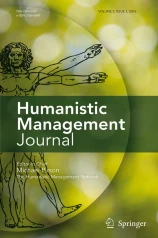
The Humanistic Management Journal is a double-blind peer reviewed journal that spans disparate fields including business ethics, environmental sustainability, social responsibility and management studies, in a humanistic research paradigm. It is a venue for thought leaders from academia, practice and public policy:
You may search for other articles here: https://www.ssrn.com/link/Humanistic-Management.html
Current Issue:
Check Out Our Collections
This themed collection aims to bring together all the papers written on Well Being and Flourishing as Goal of Management. It is exploring the conceptual foundations of well-being and flourishing as relevant outcomes for managerial practice. The collection also explores how Well-Being and Flourishing are supporting a humanistic paradigm for management. Furthermore, the collection explores how the concepts can serve as foundation of a new understanding for leadership more broadly, inform teaching, research, practice and policy.
This themed collection aims to bring together papers written on Humanistic Management Education and Pedagogy. It is building on prior volumes on Humanistic Education and Humanistic Management Pedagogy. The collection provides conceptual work and applied research on how to engage learners in personal development, and self-awareness practices. Other pieces focus on the pedagogy of applying dignity-based and well-being oriented management and leadership practices.
This themed collection aims to bring together all the papers written on Dignity as a Concept and as Foundation of Humanistic Management. It is exploring the conceptual and practical relevance of dignity and how it can support better management and leadership practices. The collection also explores how the concept can serve as foundation of a new paradigm for leadership more broadly, inform teaching, research, practice and policy.
Previous Issues
- Volume 10, Issue 2, August 2025
- Volume 10, Issue 1, April 2025
- Volume 9, Issue 3, December 2024
- Volume 9, Issue 2, August 2024: Special Issue on Love and Meaningful Organizing
- Volume 9, Issue 1, April 2024
- Volume 8, Issue 3, December 2023
- Volume 8, Issue 2, August 2023: Special Issue: From Profession to Purpose: discerning the authentic self of economic actors in the new normal
- Volume 8, Issue 1, April 2023
- Volume 7, Issue 3, December 2022
- Volume 7, Issue 2, October 2022: Special Issue on Thinking About the Future of Work: Promoting Dignity and Human Flourishing
- Volume 7, Issue 1, April 2022
- Volume 6, Issue 3, December 2021: Special Issue on Transforming Systems through Humanistic Management
- Volume 6, Issue 2, July 2021
- Volume 6, Issue 1, April 2021
- Volume 5, Issue 2, December 2020: Special Issue on Bringing the Humanities and Liberal Learning to the Study of Business
- Volume 5, Issue 1, July 2020: Special Issue on Building Institutions for the Common Good
- Volume 4, Issue 2, December 2019: Special Issue on Social Innovation and the Future of Business and Business Education
- Volume 3 Issue 2: December 2018: Special Section: A World Ethos for Global Business?
- Volume 3 Issue 1: July 2018: Humanistic Management – Sucks Less and Better for your Health
- Volume 2 Issue 1: Oct 2017: World Ethos and Narrative
- Volume 1 Issue 2: April 2017: Social Upheaval and Humanistic Management
- Volume 1 Issue 1: Sept 2016: Introduction to Humanistic Management

Editor-in-Chief
Michael Pirson, Fordham University, Bronx, NY, USA
Associate Editors
David M. Wasieleski, Department Chair, Management & Marketing; Professor of Management & Business Ethics, Duquesne University
Claus Dierksmeier, Professor and Director, Center for Global Ethic (Weltethos Insitut), University of Tuebingen, Germany
Domènec Melé, PhD, Professor of Business Ethics, IESE Business School, Spain
Call for Papers for Next Issue
Submission Deadline (Journal):
Details and submission information at: https://www.springer.com/philosophy/ethics+and+moral+philosophy/journal/41463?detailsPage=press
Overview
Humanistic Management Journal is a venue for multi-disciplinary research promoting human dignity and well-being in economic systems.
- Focuses on the interplay of business ethics, environmental and social sustainability, and management studies.
- Promotes humanistic management trends towards social entrepreneurship and cooperative capitalism.
- Offers a platform for researchers, practitioners, and policymakers interested in life-conducive economic systems.
- Implements a double-blind peer review system for quality assurance.
Editor in Chief
Michael Pirson PhD

Aims and scope
The humanistic management journal focuses on the protection of human dignity and the promotion of human well-being within the context of organizing. Work within the above paradigmatic pillars can focus on the individual, group, organizational, systemic, and philosophical levels. The journal encourages contributions from various disciplinary perspectives representing the consilience of knowledge, e.g. contributions from psychology, sociology, economics, cybernetics, physics, evolutionary biology, anthropology etc, as well as interdisciplinary and transdisciplinary contributions are encouraged. In similar fashion, perspectives from academia, practice and public policy are encouraged. As social business and entrepreneurship and conscious, regenerative, and cooperative capitalism gain visibility, this is a forum for researchers, practitioners, and policy makers interested in a life-conducive economic system for which humanistic management is critical.
Primary research or secondary analysis of primary research request a minimum of two peer reviewers and follow external peer-review according to the journal’s editorial procedures as described here. Further details on how reviewers are selected can be found here.
Editorial board
Editor in Chief
Michael Pirson PhD
Fordham University, New York, United States
Associate Editors
Elena P. Antonacopoulou PhD
American University of Beirut, Cyprus
Joan Fontrodona MBA, PhD
IESE Business School, Barcelona, Spain
Matthew T. Lee PhD
Baylor University, Waco, United States; Harvard University, Cambridge, United StatesDomènec Melé MSc, PhD
IESE Business School, Barcelona, Spain
Editorial Board
Romina Boarini PhD
Organisation de Coopération et de Développement Economiques, Paris, France
Jane Dutton PhD
University of Michigan–Ann Arbor, Ann Arbor, United States
Ed Freeman BA, PhD
University of Virginia, Charlottesville, United States
Mary Gentile PhD
Babson College, Wellesley, United States; Founder, Giving Voice to Values, United StatesAnil Gupta PhD
Founder, Honey Bee Network, India; Indian Institute of Management Ahmedabad, Ahmedabad, IndiaAndre Habisch PhD
Catholic University of Eichstätt-Ingolstadt, Eichstätt, GermanyJonas Haertle PhD
United Nations Global Compact (PRME), United StatesDonna Hicks PhD
Harvard University, Cambridge, United StatesEllen Langer PhD
Harvard University, Cambridge, United StatesChris Laszlo PhD
Case Western Reserve University, Cleveland, United StatesL. Hunter Lovins PhD
Natural Capitalism Solutions (NCS), United States
Roger Martin PhD
Rotman School of Business, Canada, retired 2013
Henry Mintzberg PhD
McGill University, Montreal, Canada
John-Christopher Spender PhD
Kozminski University, Warsaw, Poland
Consuelo Garcia la de Torre PhD
Tecnológico de Monterrey, Monterrey, Mexico
Shann Turnbull PhD
Institute for Self-Governance, Australia
Sandra Waddock BA, MA, MBA, PhD
Boston College, Boston, United States
Review Board
Ricardo Aguado PhD
Universidad de Deusto, Bilbao, Spain
Osmar Arandia PhD
University of Monterrey, Garza García, Mexico
Robert Blomme PhD
Nyenrode Business University, Breukelen, The Netherlands
Jeanne Buckkeye PhD
University of St. Thomas - Minnesota, Saint Paul, United States
Cinzia Cessi PhD
University of Cagliari, Cagliari, Italy
Juan Felipe Espinosa PhD
Federico Santa María Technical University, Valparaíso, Chile
Ignacio Ferrero PhD
Universidad de Navarra, Pamplona, Spain
Michela Floris PhD
University of Cagliari, Cagliari, Italy
Ernestina Giudici PhD
University of Cagliari, Cagliari, Italy
Harry Hummels PhD
Maastricht University, Maastricht, The Netherlands
Sertan Kabadayi PhD
Fordham University, New York, United States
Tae Wan Kim PhD
Carnegie Mellon University, Pittsburgh, United States
Monika Kostera PhD
Jagiellonian University, Krakow, Poland
Mario Maguirre PhD
University of Monterrey, Garza García, Mexico
P. Mattijs Mbal PhD
University of Lincoln, Lincoln, United Kingdom
Editorial Policies
Rights and Permissions
Ethics & disclosures
The journal is committed to maintaining the highest level of integrity in the content published.
This journal has a competing interest policy in place.
All Springer Nature journals require authors to comply with international, national and/or institutional standards of research reporting. This is particularly important for studies involving human and/or animal participants, their data and biological material, and Informed Consent.
The journal is a member of the Committee on Publication Ethics (COPE). It subscribes to COPE's principles for addressing misconduct. This means the journal is committed to investigating any allegations of misconduct, to maintain the integrity of research.
The journal may use plagiarism detection software to screen submissions. If plagiarism is identified, the (COPE) guidelines on plagiarism will be followed.
Research content published in this journal is peer reviewed (double-anonymous).


Contact the Journal
The fastest way to find answers to questions about our journals and submissions is usually to search in our support portal.
You can track the progress of your submission in the 'Your research' section of your Springer Nature account.
If you cannot find the answer you need in our support portal or your Springer Nature account, you can request support.